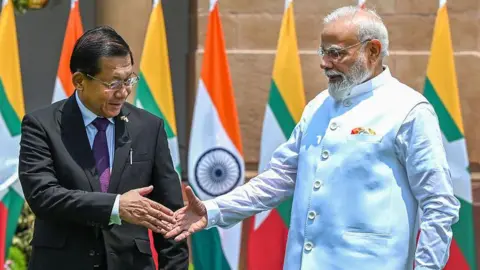
The Rohingya Justice Initiative (RJI) strongly condemns India’s reception of Myanmar’s military-backed president, Min Aung Hlaing, and calls attention to India’s obligations to humanity, international law, and its own stated commitments to justice and human rights.
Min Aung Hlaing is not merely a visiting head of state — he is a central figure in ongoing allegations of genocide, crimes against humanity, and war crimes, particularly against the Rohingya people. His presence on Indian soil represents an attempt to normalize impunity under the guise of diplomatic engagement.
India, as the world’s largest democracy and a state that has long championed moral leadership on the global stage, cannot ignore its legal and ethical responsibilities. India is a signatory to key international frameworks, including the Universal Declaration of Human Rights (UDHR); the 1948 Genocide Convention; the 1949 Genocide Conventions; the Convention on the Rights of the Child (CRC); and other human rights instruments that demand protection of civilians in conflict. Importantly, Article 1 of the Genocide Convention places an obligation on India to prevent or punish the crime of genocide, as a signatory to the Convention.
These commitments collectively establish a clear expectation: states must not aid, legitimize, or provide safe passage to individuals credibly accused of mass atrocities without pursuing accountability.
While India is not a party to the Rome Statute of the International Criminal Court (ICC), this does not absolve it of responsibility. The principle of universal accountability for grave international crimes remains a cornerstone of modern international law. The ICC has already exercised jurisdiction over aspects of the Rohingya crisis (notably the cross-border deportation into Bangladesh), and investigators continue to build cases against Myanmar’s senior leadership.
RJI therefore calls on the Government of India to:
- Publicly acknowledge the gravity of allegations against Min Aung Hlaing and refrain from actions that confer legitimacy on his leadership
- Condition all diplomatic engagement on measurable human rights benchmarks and concrete steps toward democratic restoration
- Support international justice mechanisms, including cooperation with UN investigative bodies and evidence-sharing frameworks
- Support legal pathways to ensure accountability of Min Aung Hlaing for the crimes committed in accordance with international law.
India stands at a defining moment. It must decide whether to prioritize short-term geopolitical calculus or long-term moral credibility and global leadership. Stability built on injustice is unsustainable; peace without accountability is illusory.
The people of Myanmar—and especially the Rohingya—are not asking for symbolism. They are asking for justice, dignity, and the rule of law.
RJI urges India to act not only as a regional power, but as a guardian of humanity.
For further inquiries, please contact sayedul@therji.org.